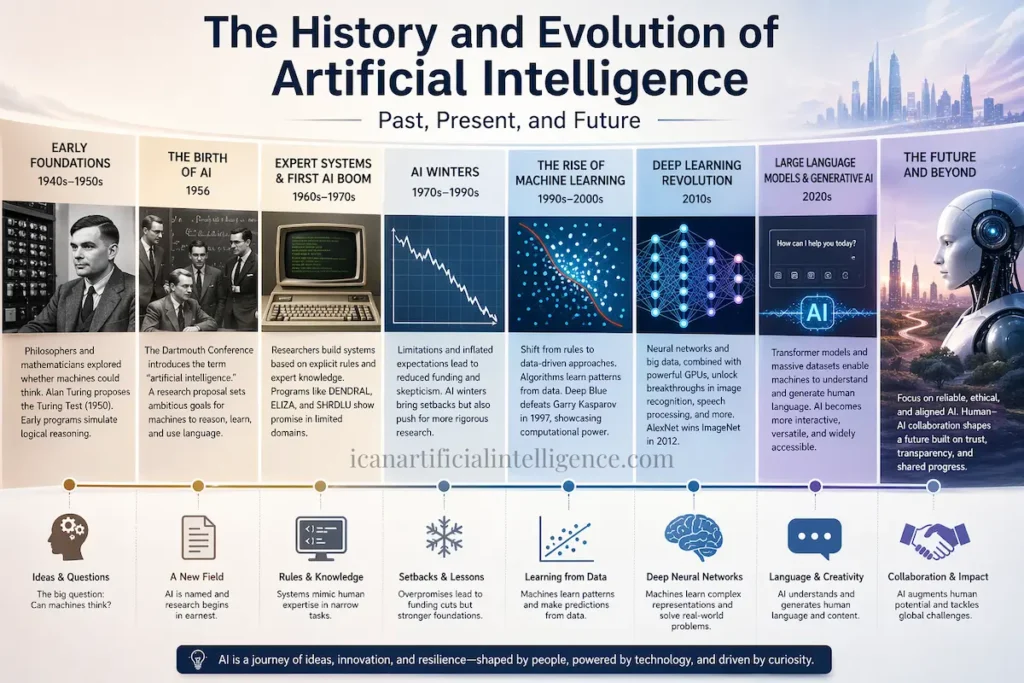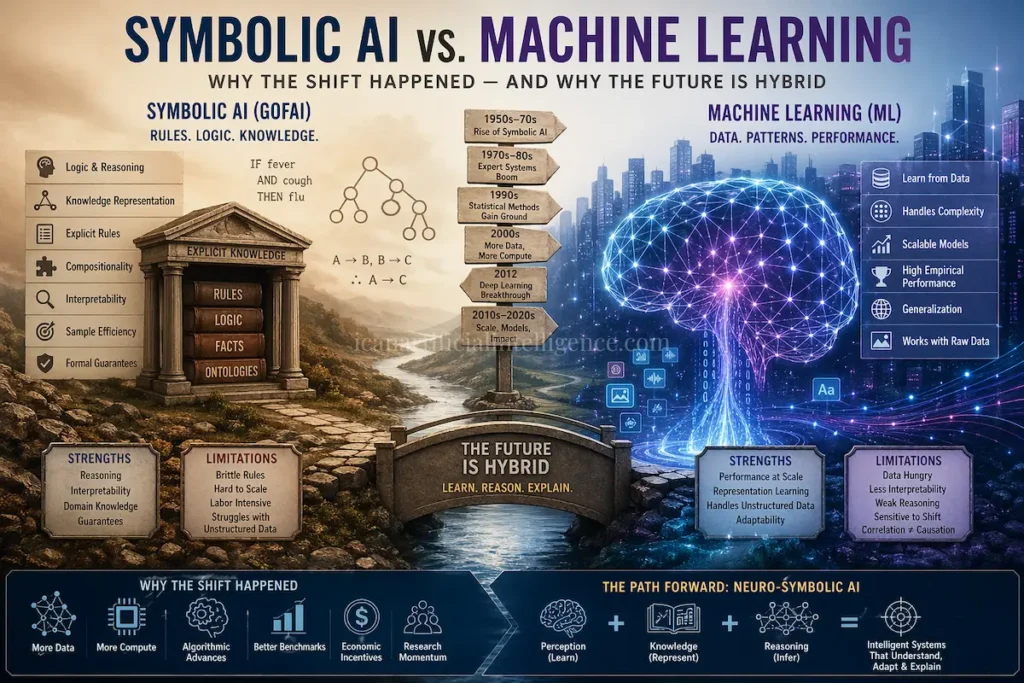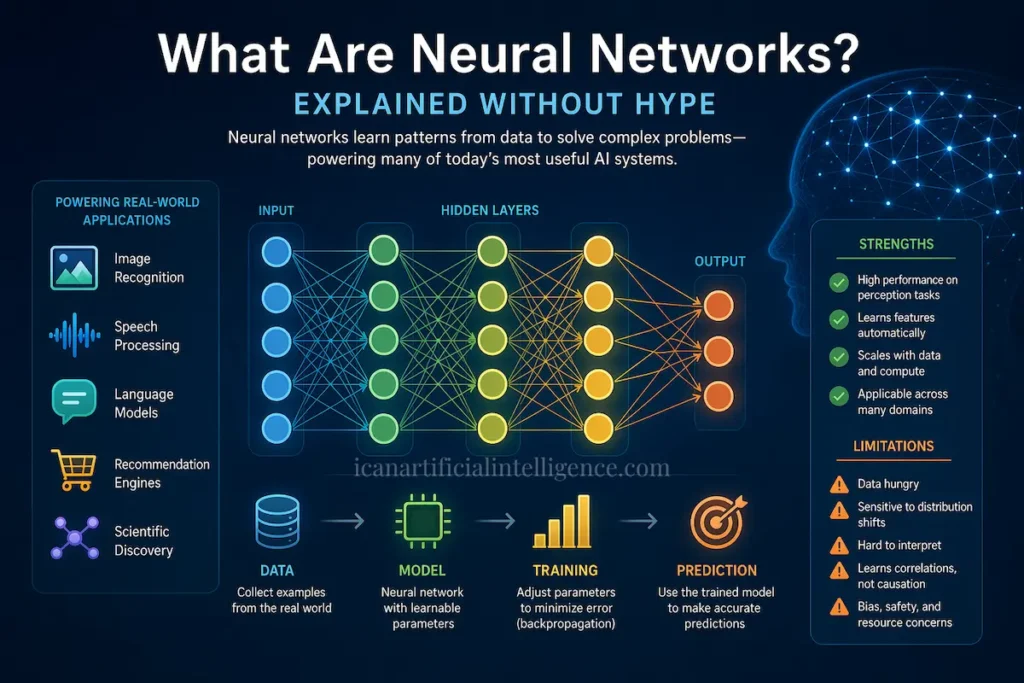
Machine learning (ML) is one of the most important technologies shaping the modern world. From personalized recommendations on Netflix to fraud detection in banking and breakthroughs in healthcare, machine learning quietly powers systems we interact with every day.
At its core, machine learning allows computers to learn from data instead of following fixed instructions. This ability to improve performance through experience is what separates modern AI systems from traditional software.
This article offers a clear conceptual and technical introduction to machine learning, designed for beginners, professionals exploring AI, and anyone who wants a solid foundation without unnecessary hype. By the end, you’ll understand what machine learning really is, how machines learn, and why it matters so much today.
What Is Machine Learning?
Learning Patterns From Data
Machine learning is a branch of artificial intelligence that enables systems to identify patterns in data and make predictions or decisions based on those patterns.
Instead of telling a computer exactly what to do step by step, we give it:
- Data
- A learning algorithm
- A goal (such as predicting, classifying, or optimizing something)
Over time, the system improves its performance by learning from examples.
Simple definition:
Machine learning is the science of enabling computers to learn from data and improve with experience.
Machine Learning vs Traditional Programming
To understand ML properly, it helps to compare it with traditional programming.
Traditional Programming
- Rules are written by humans
- Data is processed using fixed logic
- Output is predictable
Machine Learning
- Rules are learned from data
- Logic emerges automatically
- Output improves as more data is used
Example:
In traditional programming, you might write hundreds of rules to detect spam emails.
In machine learning, you show the system thousands of spam and non-spam emails — and it learns what spam looks like.
This shift is why machine learning scales so well to complex problems humans struggle to define precisely.
Real Example: Email Spam Filters
Email spam filters are one of the earliest and most successful uses of machine learning.
They learn by analyzing:
- Email content
- Sender behavior
- User feedback (marking emails as spam or not)
Over time, the model adapts to new spam tactics — something rule-based systems struggle to do.
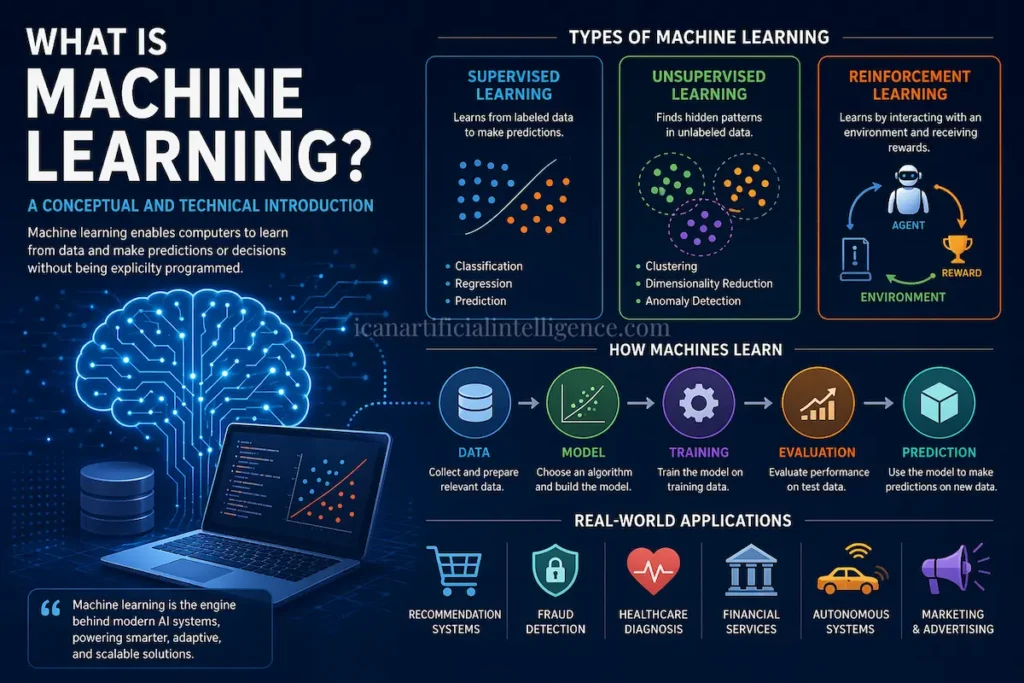
Types of Machine Learning
Machine learning is broadly divided into three main categories, each suited to different problems.
Supervised Learning
What it is:
The model learns from labeled data, meaning each input has a known output.
How it works:
- You provide examples (input + correct answer)
- The algorithm learns a mapping between them
- It predicts outputs for new, unseen data
Examples:
- Predicting house prices
- Email spam detection
- Medical diagnosis systems
- Credit scoring
Common algorithms:
- Linear Regression
- Logistic Regression
- Decision Trees
- Support Vector Machines
- Neural Networks
Supervised learning is the most widely used form of machine learning in real-world applications.
Unsupervised Learning
What it is:
The model works with unlabeled data and tries to discover hidden patterns on its own.
What it finds:
- Clusters
- Relationships
- Data structure
Examples:
- Customer segmentation
- Market basket analysis
- Anomaly detection
- Topic modeling in text data
Common algorithms:
- K-Means Clustering
- Hierarchical Clustering
- Principal Component Analysis (PCA)
- Autoencoders
Unsupervised learning is especially useful when labeling data is expensive or impractical.
Reinforcement Learning
What it is:
An agent learns by interacting with an environment and receiving rewards or penalties.
Key idea:
Learning through trial and error.
Examples:
- Game-playing AI (Chess, Go)
- Robotics
- Self-driving cars
- Dynamic pricing systems
Core components:
- Agent
- Environment
- Actions
- Rewards
Reinforcement learning is powerful but complex, and it often requires significant computational resources.
How Machines Learn
Understanding how learning happens removes much of the mystery around machine learning.
Algorithms and Optimization
Machine learning models rely on algorithms that:
- Make predictions
- Measure how wrong those predictions are
- Adjust themselves to reduce errors
This adjustment process is called optimization.
Most models aim to minimize a loss function, which quantifies prediction error.
Training, Testing, and Validation
To ensure reliable performance, data is usually split into three parts:
- Training data: Used to teach the model
- Validation data: Used to tune parameters
- Test data: Used to evaluate final performance
This prevents the model from simply memorizing data — a problem known as overfitting.
Importance of Data Quality
A powerful algorithm cannot compensate for poor data.
Key data factors include:
- Accuracy
- Completeness
- Bias
- Relevance
A common saying in machine learning is:
“Garbage in, garbage out.”
High-quality data often matters more than the choice of algorithm.
Real-World Applications of Machine Learning
Machine learning is not experimental anymore — it’s operational across industries.
Consumer Technology
- Voice assistants (Siri, Alexa, Google Assistant)
- Recommendation engines (YouTube, Netflix, Amazon)
- Image recognition and search
- Personalized advertising
Healthcare
- Disease prediction
- Medical imaging analysis
- Drug discovery
- Personalized treatment plans
Machine learning helps doctors make faster and more accurate decisions.
Finance and Banking
- Fraud detection
- Credit risk assessment
- Algorithmic trading
- Customer behavior analysis
Banks rely heavily on ML to manage risk and detect anomalies in real time.
Autonomous Systems
- Self-driving cars
- Drones
- Robotics
- Smart traffic systems
These applications combine machine learning with sensors, real-time data, and reinforcement learning.
Common Misconceptions About Machine Learning
Despite its popularity, machine learning is often misunderstood.
- ML is not magic
- ML does not “think” like humans
- ML does not always need massive datasets
- ML models are not automatically unbiased
Understanding limitations is just as important as understanding capabilities.
Why Machine Learning Matters Today
Machine learning is foundational to modern AI systems because it enables:
- Scalability
- Adaptability
- Automation of complex tasks
- Continuous improvement
It’s also the backbone of advanced technologies like deep learning and large language models.
Conclusion
Machine learning is the engine driving modern artificial intelligence. By allowing systems to learn from data instead of rigid rules, it enables smarter, more adaptive, and scalable solutions across industries.
Whether you’re a student, professional, entrepreneur, or simply curious about AI, understanding machine learning is a critical step. It lays the foundation for exploring neural networks, deep learning, and large language models — technologies that will shape the future of work and society.
This article is designed to be a long-term reference point, and as machine learning evolves, it will continue to remain relevant at the core.
References and Further Reading
For readers who want deeper technical or academic insights:
- Pattern Recognition and Machine Learning – Christopher M. Bishop
- Machine Learning: A Probabilistic Perspective – Kevin P. Murphy
- Stanford CS229 Lecture Notes
- Google Machine Learning Crash Course
- MIT OpenCourseWare – Machine Learning
This article presents a historical and conceptual overview based on widely accepted academic and industry sources.