Artificial Intelligence is no longer optional for businesses it’s a competitive necessity. From startups to global enterprises, companies are leveraging AI to automate operations, reduce costs, and unlock new growth opportunities.
In this guide, we’ll break down how companies actually use AI, the strategies behind it, and how you can apply the same principles—whether you run a business, work in one, or plan to start one.
Why AI Is Transforming Business
AI combines machine learning, data analysis, and automation to help businesses:
- Make faster decisions
- Reduce operational costs
- Improve customer experience
- Scale without increasing workforce proportionally
Companies that adopt AI early often gain a massive competitive edge.
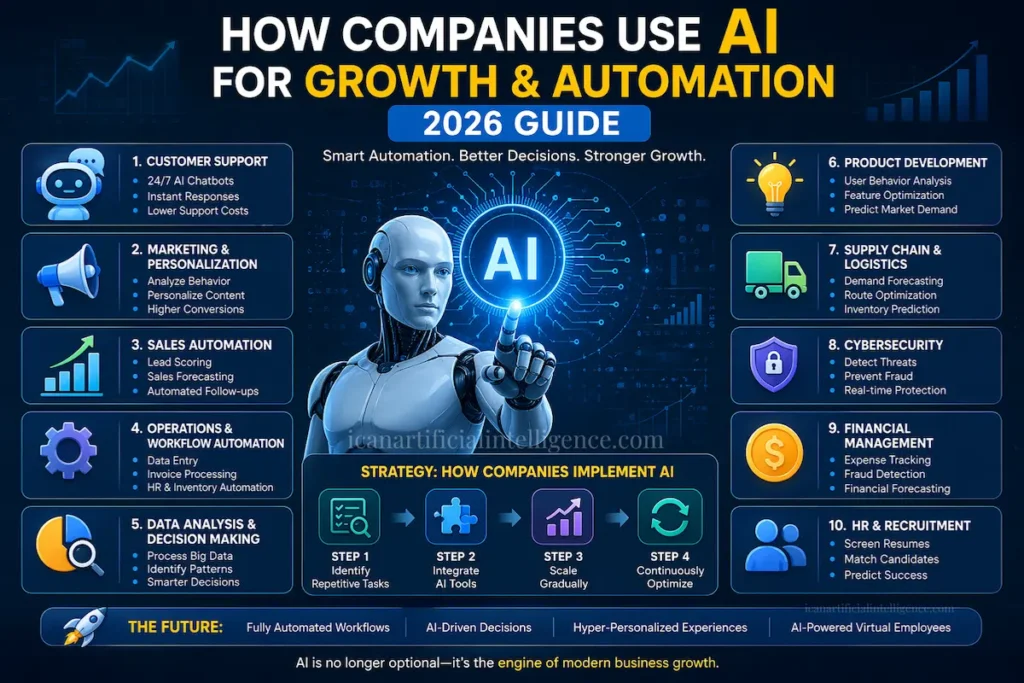
1. AI in Customer Support (24/7 Automation)
One of the most common uses of AI is in customer service.
How It Works:
- AI chatbots handle queries instantly
- Natural language processing enables human-like conversations
- AI learns from past interactions
Benefits:
- 24/7 availability
- Reduced support costs
- Faster response times
Example Use Cases:
- E-commerce support
- Banking queries
- Technical troubleshooting
Monetization Angle:
Promote:
- AI chatbot platforms
- Customer support SaaS tools
2. AI in Marketing & Personalization
Marketing has been revolutionized by AI.
What AI Does:
- Analyzes customer behavior
- Predicts preferences
- Personalizes content and ads
Real Impact:
- Higher conversion rates
- Better targeting
- Improved ROI
Examples:
- Product recommendations
- Email marketing automation
- Ad targeting systems
3. AI for Sales Automation
AI helps sales teams close deals faster.
Capabilities:
- Lead scoring
- Sales forecasting
- Automated follow-ups
Benefits:
- Focus on high-quality leads
- Reduced manual effort
- Increased revenue
4. AI in Operations & Workflow Automation
Businesses use AI to streamline internal processes.
Tasks AI Can Automate:
- Data entry
- Invoice processing
- Inventory management
- HR workflows
Result:
Massive efficiency gains and fewer human errors.
5. AI in Data Analysis & Decision Making
Data is one of the most valuable assets for any company.
What AI Does:
- Processes large datasets
- Identifies patterns
- Generates insights
Outcome:
- Smarter business decisions
- Reduced risk
- Faster strategic planning
6. AI in Product Development
AI is helping companies build better products.
Applications:
- User behavior analysis
- Feature optimization
- Predictive modeling
Example:
Tech companies use AI to:
- Improve user experience
- Test product features
- Predict market demand
7. AI in Supply Chain & Logistics
AI is optimizing global supply chains.
Use Cases:
- Demand forecasting
- Route optimization
- Inventory prediction
Benefits:
- Reduced costs
- Faster delivery
- Better resource management
8. AI in Cybersecurity
As businesses grow digitally, security becomes critical.
How AI Helps:
- Detects unusual behavior
- Prevents fraud
- Responds to threats in real time
Importance:
Cybersecurity powered by AI is becoming essential—not optional.
9. AI for Financial Management
Finance teams are increasingly using AI tools.
Capabilities:
- Expense tracking
- Fraud detection
- Financial forecasting
Outcome:
More accurate and efficient financial operations.
10. AI in HR & Recruitment
Hiring is becoming smarter with AI.
What AI Does:
- Screens resumes
- Matches candidates
- Predicts employee success
Benefit:
Faster and better hiring decisions.
Real-World Strategy: How Companies Implement AI
Successful companies don’t just “use AI”—they follow a strategy.
Step 1: Identify Repetitive Tasks
Start with areas that consume time and resources.
Step 2: Integrate AI Tools
Use existing platforms instead of building from scratch.
Step 3: Scale Gradually
Expand AI usage across departments.
Step 4: Continuously Optimize
AI improves with data—keep refining processes.
How Small Businesses Can Use AI
You don’t need a huge budget to use AI.
Affordable Use Cases:
- Chatbots for customer support
- AI writing tools for content
- Marketing automation tools
Key Insight:
AI levels the playing field between small businesses and large enterprises.
Future of AI in Business
Looking ahead, we can expect:
- Fully automated business workflows
- AI-driven decision systems
- Hyper-personalized customer experiences
- AI-powered virtual employees
Businesses will increasingly operate with AI at their core.
Conclusion: AI Is the Engine of Modern Business Growth
Artificial Intelligence is no longer a futuristic investment—it’s a present-day necessity for businesses aiming to grow, compete, and scale efficiently.
From automating customer support to optimizing supply chains and enabling smarter decision-making, AI is transforming every layer of business operations. What once required large teams and significant resources can now be handled faster, cheaper, and more accurately with AI-powered systems.
The key takeaway is simple:
Businesses that adopt AI strategically will outperform those that don’t.
As AI continues to evolve, the gap between AI-enabled companies and traditional businesses will only widen. Whether you’re a startup founder, a professional, or an enterprise leader, now is the time to understand and implement AI in meaningful ways.
To explore the broader landscape shaping this transformation, read our guide on “Top Emerging Technologies in 2026”.
References & Further Reading
To ensure accuracy and credibility, this article is based on insights from industry leaders, research organizations, and technology companies:
- McKinsey & Company – Reports on AI adoption in business and automation trends
- Gartner – Research on AI strategies and enterprise implementation
- IBM – Insights on AI in business operations and automation
- Microsoft – AI tools, cloud automation, and enterprise solutions
- Google – AI research, machine learning, and real-world applications
- Stanford University – AI Index Report (global AI trends and data)