Artificial Intelligence is no longer a futuristic concept—it’s a daily utility. From writing emails to automating entire workflows, AI tools are transforming how we work, learn, and live.
In this guide, we’ll break down the most useful AI tools across different categories, explain how they work, and show you how to use them effectively—whether you’re a student, professional, creator, or entrepreneur.
Why AI Tools Matter Today
AI tools are built on advancements in machine learning and deep learning, enabling systems to understand language, images, and behavior patterns.
Instead of replacing humans, modern AI tools act as productivity amplifiers:
- Save time on repetitive tasks
- Improve decision-making
- Enhance creativity
- Automate workflows
If you’ve read our previous articles on Machine Learning and Neural Networks, you already understand the foundation behind these tools.
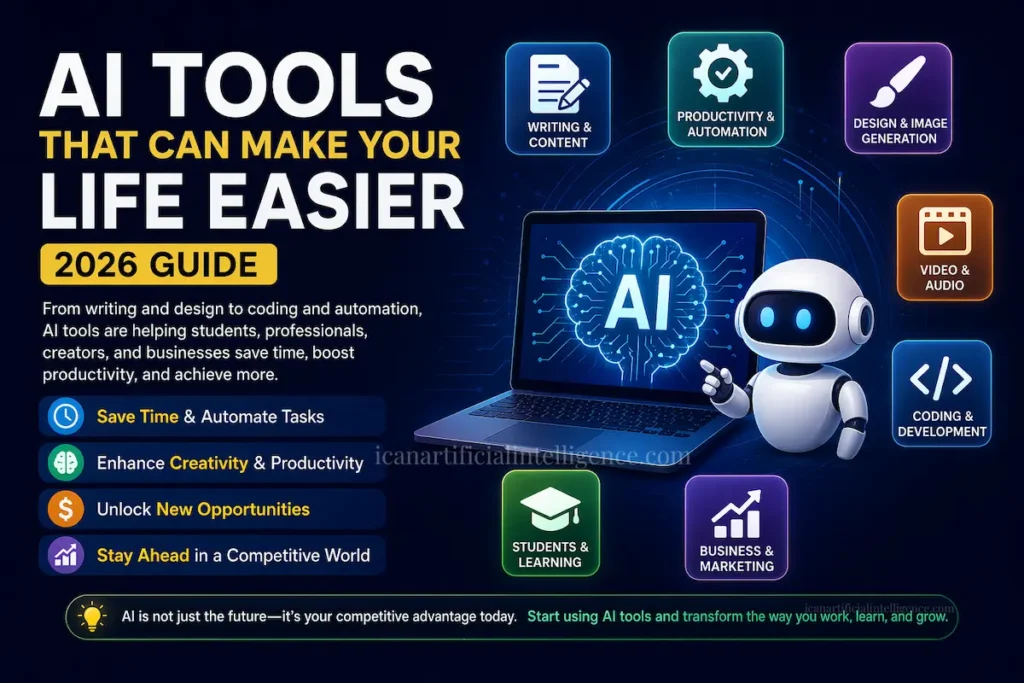
Categories of AI Tools You Should Know
To make things simple, we’ll divide AI tools into practical categories based on real-world usage.
1. AI Writing & Content Creation Tools
These tools help generate blogs, emails, scripts, and even books.
Key Use Cases:
- Blog writing
- Copywriting for ads
- Email drafting
- Social media content
Popular Tools:
- Chat-based AI assistants
- AI copywriting platforms
- Grammar & rewriting tools
Why They Matter:
They reduce content creation time from hours to minutes while maintaining quality.
Monetization Tip:
You can:
- Promote premium writing tools via affiliate links
- Use them to scale your own blog content (like this site)
2. AI Tools for Productivity & Automation
These tools help automate daily tasks and improve workflow efficiency.
Examples of Tasks:
- Scheduling meetings
- Managing emails
- Summarizing documents
- Task automation
Benefits:
- Saves hours every week
- Reduces mental load
- Improves organization
Real-World Example:
A professional can automate:
- Meeting notes
- Follow-up emails
- Data entry
3. AI Design & Image Generation Tools
AI can now create stunning visuals from simple text prompts.
What You Can Create:
- Social media graphics
- Website banners
- Product mockups
- Digital art
Why This Is Powerful:
You no longer need advanced design skills to create professional visuals.
Monetization Tip:
- Sell AI-generated designs
- Offer freelance services
- Create print-on-demand products
4. AI Video & Audio Tools
Video content is dominating the internet—and AI is making it easier than ever.
Capabilities:
- Convert text into videos
- Generate voiceovers
- Edit videos automatically
- Remove background noise
Who Should Use This:
- YouTubers
- Content creators
- Businesses
Opportunity:
Start a faceless YouTube channel powered entirely by AI.
5. AI Coding & Development Tools
AI is revolutionizing software development.
What These Tools Do:
- Suggest code in real-time
- Debug errors
- Generate entire functions
- Assist beginners in learning programming
Impact:
- Faster development cycles
- Lower barrier to entry for beginners
6. AI Tools for Students & Learning
Students benefit massively from AI-powered learning tools.
Use Cases:
- Summarizing textbooks
- Solving problems
- Language learning
- Research assistance
Advantage:
Personalized learning at scale.
7. AI Tools for Business & Marketing
Businesses use AI to scale faster with fewer resources.
Applications:
- Customer support chatbots
- Email marketing automation
- Data analysis
- Ad optimization
Result:
Higher ROI with less manual effort.
How to Choose the Right AI Tool
With thousands of tools available, choosing the right one can be overwhelming.
Consider These Factors:
- Ease of use
- Pricing (free vs paid)
- Integration with your workflow
- Output quality
Pro Tip:
Start with free versions, then upgrade once you see value.
The Future of AI Tools
AI tools are evolving rapidly. In the coming years, expect:
- More personalized AI assistants
- Fully automated workflows
- AI integrated into everyday devices
- Smarter decision-making systems
AI will move from being a tool to becoming a collaborative partner.
How This Connects to Your AI Learning Journey
This article builds on your understanding from:
- What is Machine Learning?
- Symbolic AI vs Machine Learning
- Neural Networks Explained
- Why Deep Learning Worked
Those concepts explain how AI works, while this guide shows how AI is used in real life.
Final Thoughts
AI tools are not just for tech experts—they are for everyone.
Whether you want to:
- Save time
- Make money online
- Improve productivity
- Learn faster
AI tools can give you a significant advantage.
The key is simple:
Start using them today, and evolve with the technology.
Conclusion: AI Tools Are the New Productivity Engine
AI tools are no longer optional—they are becoming essential for anyone looking to stay competitive in a fast-changing world. From writing and design to coding and business automation, these tools help individuals and organizations work smarter, not harder.
The real advantage of AI tools lies in their ability to scale your efforts. Tasks that once required hours can now be completed in minutes, allowing you to focus on creativity, strategy, and growth.
However, the key is not to use every available tool, but to choose the ones that genuinely improve your workflow and solve real problems. When used correctly, AI tools can significantly boost productivity, open new income opportunities, and enhance decision-making.
As AI continues to evolve, those who learn to use these tools effectively will have a clear advantage—both professionally and personally.
References & Further Reading
For readers who want to explore AI tools and their underlying technologies in more depth:
- OpenAI – Research and tools in generative AI
- Google – AI tools and machine learning advancements
- Microsoft – AI-powered productivity tools and cloud services
- MIT OpenCourseWare – Free courses on AI and machine learning
- Stanford University – AI research and technical resources
- McKinsey & Company – Reports on AI adoption and business impact